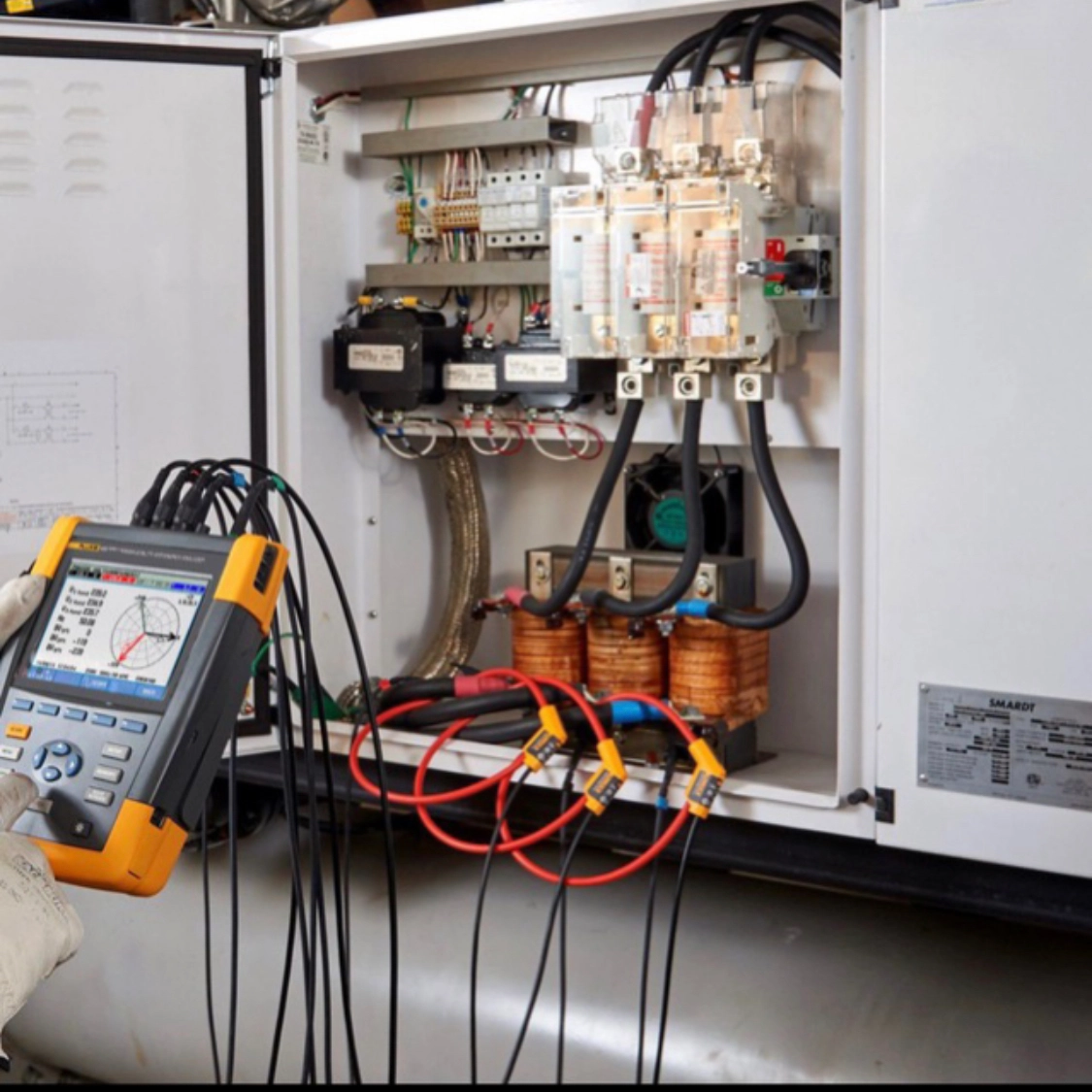
Defining Power Factor
Power factor is the ratio of real power (kW) to apparent power (kVA). A power factor of 1.0 means all current drawn from the supply is doing useful work. Utilities charge for apparent power demand (kVA) or penalize customers whose power factor falls below a threshold (typically 0.90 or 0.95 lagging) because low power factor increases loading on their distribution infrastructure.
Displacement vs. True Power Factor
Traditional power factor — the cosine of the phase angle between voltage and current — is technically displacement power factor. It ignores the effect of harmonic currents on total apparent power. True power factor accounts for both displacement and distortion. In a system with significant harmonic content, true power factor can be substantially lower than displacement power factor even if the fundamental has been corrected to unity.
Where Power Quality Enters the Picture
Power quality encompasses voltage magnitude, frequency, waveform shape, symmetry and stability. Power factor is one symptom of a power quality condition (reactive power imbalance) but does not capture voltage sags, harmonics, transients, flicker or imbalance — all of which cause equipment damage independently of power factor.
The Capacitor Bank Resonance Trap
A classic scenario: a facility installs capacitor banks to correct low displacement power factor. Power factor improves. Months later, capacitor banks fail. Root cause: harmonic currents were flowing undetected. The capacitors lowered the system resonance frequency into alignment with a dominant harmonic order, driving harmonic currents to destructive levels. This scenario is one of the most common failure modes when power factor correction is implemented without harmonic analysis.
Why Power Factor Alone Is Not Enough
A facility can have a corrected power factor of 0.99 and still have serious power quality problems driving equipment failures, production losses, and energy waste. The two are managed through different analyses, different measurements, and often different mitigation equipment.
Frequently Asked Questions
Does adding a capacitor bank improve power quality?
It depends on the harmonic environment. In a low-harmonic system, capacitor banks improve displacement power factor. In a high-harmonic system, unfiltered capacitors can cause resonance amplification and make power quality significantly worse. Always conduct a harmonic study before installing capacitor banks.